

For years, the aftermarket sector has associated “lost sales” with a single problem: not having stock available at the moment of request.
It is a familiar metric. Painful. And apparently controllable.
But it is only the visible part.
Reducing lost sales to stock availability is a convenient simplification. Every day, customers perform searches in catalogs and webshops, and also make inquiries by phone or WhatsApp that form part of the real demand of the business. This activity is explicit demand. Measurable demand. Strategic demand.
And yet, in most companies, only what turns into an order is analyzed. Everything else disappears.
When a customer searches for a part number but cross-reference towards the product doesn’t exists.
When the product range is incomplete and forces the customer to look elsewhere.
When the price is not competitive on a sensitive item.
When an identification error causes silent abandonment.
None of this is usually recorded as a “lost sale”.
The sale simply does not happen.
And what is not recorded is not managed.
After analyzing hundreds of thousands of real interactions in aftermarket distribution environments, the pattern is clear: stock availability is only a fraction of the problem. In certain operators, the structural loss associated with missing cross-references, range deficiencies or pricing friction can multiply by three the classic lost sale attributed to availability.
And in many organizations, even stock-related lost sales tend to be managed as an operational estimate rather than as a strategic metric.
The problem is not stock. Is the demand you are not converting — and not even seeing.
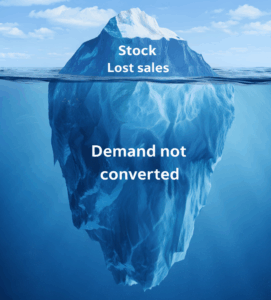
The real challenge is mastering Demand Conversion.
Demand Conversion is the ability to transform every real commercial interaction — not just recorded orders — into effective sales.
It requires answering uncomfortable questions:
How much real demand do we receive every day?
What percentage turns into sales?
Where does the opportunity break?
What part truly depends on stock and what part relates to catalog, range or pricing?
How much commercial potential are we losing without even seeing it?
When you start measuring total demand, something revealing appears: A large part of the improvement potential does not lie in increasing stock, but in understanding the demand you are receiving and why it is not converting.
For decades, management in distribution has focused on inventory, logistics and margins. That was logical. Those were the visible levers.
The next competitive level is not there.
It lies in mastering demand information before it becomes an order… or a silent loss.
Those who control their Demand Conversion gain a structural advantage. Not because they carry more SKUs in stock, but because they know exactly which items are missing, which cross-references must be activated, which product ranges need expansion and where pricing is breaking conversion.
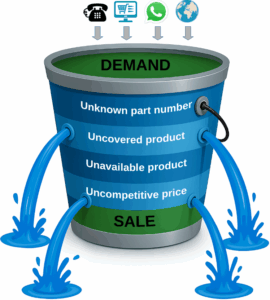
The difference is not operational. It is strategic.
Classic lost sales are what you know you have lost.
Lack of Demand Conversion is what you did not even know was at stake.
Demand Conversion is the strategic indicator that measures a company’s real capacity to transform every commercial interaction — searches, phone inquiries, WhatsApp messages and catalog checks — into effective sales.
It does not stop at recorded orders.
It includes all explicit demand generated by the market, regardless of whether it ends in a transaction.
Managing it means identifying, quantifying and correcting the structural frictions that prevent it from turning into revenue.
Demand Conversion is not an operational metric. It is a decision-making infrastructure.
And those who master their Demand Conversion stop competing on price and start competing on intelligence.
In upcoming articles, we will explore the main structural leaks that affect Demand Conversion.
By Joan Cabós
CEO & founder