
For years, most companies in the automotive aftermarket have analyzed their commercial performance in the same way.
By looking at sales.
How much we sell.
Which part numbers move the most.
Which product families generate the most revenue.
Some companies go a step further and also analyze lost sales: orders that could not be fulfilled, unavailable part numbers, or requests that never became a sale.
But even this analysis has a fundamental limitation.
It only analyzes what we already know.
Part number by part number.
Recording demand does not mean understanding it
In day-to-day operations, companies receive far more demand than what ultimately turns into sales.
That demand arrives through multiple channels -counter sales, phone, web or B2B- and is often recorded in searches, queries or logs.
The problem is not that demand doesn’t exist.
The problem is that it is rarely interpreted or measured correctly.
Many conversion inefficiencies are already present within the demand itself, but remain hidden within its fragmentation:
- Across different channels.
- Across different part numbers.
- Across different brands.
- Across multiple requests.
As a result, part of that demand gets diluted and is never recognized as potential business.
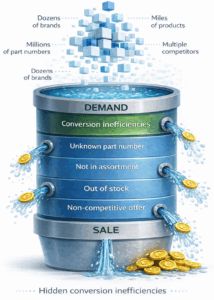
Companies record the demand they receive.
But that does not mean they are truly understanding it or measuring its economic impact.
The demand is there.
But no one is measuring it.
Conversion inefficiencies are already present within the demand itself, even before it is compared with sales.
Lost Sales vs Demand Conversion
This is where an important conceptual shift appears.
Lost sales show what we already know.
Demand Conversion reveals conversion inefficiencies that remain hidden within the demand a company is already receiving.
Lost sales explain requests that did not turn into a sale.
But Demand Conversion analyzes something much broader: all the demand a company receives and the inefficiencies that prevent part of it from turning into business.
And this is when an uncomfortable reality emerges: part of the potential business remains outside our visibility.
Inefficiencies inside and outside your visibility
When you analyze Demand Conversion, you discover that some unconverted demand lies within your operations, while another part remains outside your visibility.
On one side are the inefficiencies within your operations.
Demand exists and the company identifies it, but something prevents it from becoming a sale: availability, coverage, or competitiveness.
These are everyday operational issues, yet their real impact often becomes diluted when analyzed part number by part number.
On the other side are inefficiencies outside your visibility.
Demand also exists, but the company does not yet recognize it as a business opportunity.
This happens more often than most companies realize:
- Demand fragmented across part numbers that actually correspond to the same product.
- Products customers request but the company does not carry.
- Entire product types that reveal opportunities to expand the business.
The demand is there.
But the company is not yet seeing or quantifying it as such.
Seeing and measuring demand changes how the business is managed
Lost sales are only part of the problem.
The real opportunity lies in all the demand you are already receiving but not converting into business.
When a company begins to analyze its Demand Conversion, it stops managing only sales.
It starts managing real market demand.
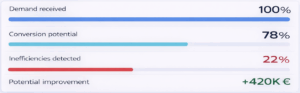
And that is when inefficiencies that were previously diluted begin to appear — along with opportunities that were never even on the company’s radar.
The key idea
Most companies know what they sell.
Some know which sales they lose.
But very few truly know how much demand they are receiving, what portion is not being converted into business, and how much money that represents.
Because when demand is not properly measured, part of the business — and the conversion inefficiencies within it — simply remain invisible.
Most companies manage sales.
The best ones start managing their demand.
In upcoming articles, we will explore the main structural leaks that affect Demand Conversion
By Joan Cabós
CEO & founder.