
The aftermarket analyzes whether something sells.
NEO detects whether it could sell.rent brand
For years, the aftermarket has tried to understand its business by looking only at sales.
When something doesn’t sell, we call it a lost sale.
But sales only tell a very small part of what is actually happening in the market.
Because before a sale exists -or even a lost sale- something much more important has already happened: market demand.
Every day, customers search for products, request part numbers, make inquiries, or try to find equivalents.
All this activity represents real market demand.
But the market is not organized by references or brands.
The market is organized around products customers are trying to solve.
And when that demand reaches a company, it cannot always be turned into business.
This is where the real problem of the aftermarket begins.
The problem the aftermarket is not seeing
Many companies believe their problem lies in sales.
But in reality, the problem starts much earlier -in the demand they receive from their customers:
- Equivalents cannot be found
- Product is not available
- There is no stock
- Offer is simply not competitive
As a result, part of that demand becomes diluted, fragmented, or simply invisible within the company’s systems.
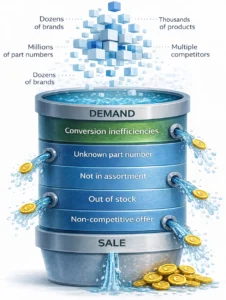
And that is why it never turns into business.
Not because the demand does not exist.
But because the company does not always have the conditions required to convert that demand into sales.
Demand Conversion
This is where a different concept appears.
It is not about looking only at sales.
It is about understanding the relationship between the demand a company receives and its real ability to convert it into business.
We can understand it in a very simple way:
Demand Conversion = Demand received × Real conversion capability
Every company receives demand. But not all that demand can be turned into business.
Demand received represents everything the market is trying to buy.
Conversion capability depends on many factors: reference equivalences, product availability, stock levels, assortment, or internal processes.
When this capability is limited by inefficiencies, part of the demand falls outside the company’s real capacity to convert it into sales.
Conversion inefficiencies
Many of these inefficiencies do not even appear in sales.
In fact, they are already present within the demand itself.
But they remain hidden because demand is usually fragmented:
• Different part numbers
• Different brands
• Different ways of searching for the same product
As a consequence, potential business becomes dispersed and is not recognized as such.
A change in perspective
Lost sales show what you already know.
Demand Conversion reveals something far more important: the inefficiencies that are limiting your business even before the sale happens.
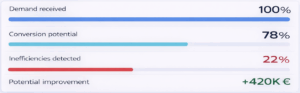
And when those inefficiencies become visible, something appears that many companies were not seeing:business opportunities that were already inside their own demand.
Understanding Demand Conversion
Understanding Demand Conversion means changing the question.
Stop asking:
Which sales am I losing?
And start asking:
How prepared is my company to convert the demand it already receives into business?
Because when demand is not properly measured, part of the business — and the inefficiencies that limit it — simply remains invisible.
The difference that changes everything
Lost sales show what you already know.
Demand Conversion reveals what you are not seeing yet.
Because the real problem is not only losing sales.
It is not being prepared to convert all the demand you are already receiving.
And in that difference lies the business many companies still cannot see.
NEO System enables companies to measure their Demand Conversion for the first time.
In upcoming articles, we will explore the main structural leakages that affect Demand Conversion.
By Joan Cabós
CEO & founder.