

For years, much of the business was built around a relatively limited number of products, brands, and part numbers.
It was possible to understand the market in depth. To identify opportunities. To detect trends. Even to anticipate many of the changes taking place in demand.
Today, reality is different.
Every year brings new part numbers, new brands, new alternatives, and new possible combinations. Catalogs keep growing. The offer keeps expanding. And complexity keeps increasing.

Companies have more information than ever before.
But having more information does not mean having more visibility.
In fact, the opposite is often true.
The greater the complexity, the harder it becomes to understand what is really happening within the demand you receive every day.
The best-selling products remain visible. Everyone knows them. They appear in the usual KPIs and receive constant attention.
The challenge lies further down.
In that vast portion of demand made up of thousands of products that may seem individually insignificant, but together represent a very important part of the business.
That is where opportunities begin to emerge, opportunities that are difficult to detect. Not because they are exceptional, but because they become diluted among thousands of signals competing for your attention.
Not because data is missing.
Not because experience is lacking.
Simply because the market has reached a level of complexity that makes it impossible to analyze everything systematically.
The question is no longer how to obtain more information.
The question is how to identify which signals deserve attention and where the real opportunities for improvement exist.
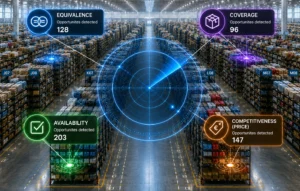
Because the problem is not that opportunities do not exist.
The problem is that you can no longer see everything.
And when you cannot see everything, you need to know where to look first.
Some of the most valuable opportunities are already hidden within your demand.
Would you like to know which ones have the greatest economic impact?
By Joan Cabós
CEO & founder